Tuesday, July 16, 2013

Mystery Patient Part 2

So a few weeks ago I shared here on this blog about a mystery patient. I have been asked to share what we figured out with the patient. The truth is we figured out nothing. He remained in HDU(High Dependeny Unit - same as a step down ICU) for a few weeks with intermittent episodes of increased work of breathing and increased PaCo2- 105. In between the episodes he would have some signs of mildly increased work of breathing but was otherwise fine. He would walk around, eat, talk etc. We did a few blood gases during these periods and they were normal.

After doing this for many days with no diagnosis in sight and realizing that whatever the diagnosis was we probably could not treat it. With this knowledge in mind a discussion was held with him and his family and a decision was made to send him to the general ward and stop the bipap. A few days later he went home. He was off the bipap for about 5 days straight before he left and had no episodes. I don't know if God healed this young man or if he since he went home and he passed on. However, I do know that this man knows the Lord and whatever happens I will see him again whether here or in heaven.

Saturday, July 6, 2013

Mimi Fundi wa kupumua

Being a respiratory therapist I am used to the question: what is it that you do? I have blogged about it a few years ago when I came to Tenwek the first time. In attempts to explain what I do I have changed my job title to Fundi wa kupumua. Fundi is a Swahili word which in language school we defined as expert. Here at Tenwek I have been told it refers to a repairman. I think either work. Kupumua is breathing. So literally translated I am the repairman of breathing.
 I have had some debates but I like the title.
The fundi part of the title here is a lot more true here than back in Canada. My troubleshooting of ventilators goes a lot further than “it doesn’t work” – I have a closet full of exhalation valves and flow sensors which I pull out when needed. I also walk around with a wrench in my pocket and have started filling O2 cylinders (E size). I am hoping to learn how the O2 and air compressor works and how to trouble shoot them so when there are problems I can fix them. This is something that is currently done and I will in no way assume the duties from technical but rather share the load.
Today I learned that when filling tanks I can’t hear my pager – something I need to remember as I start doing this more often.
Don’t think I am filling tanks and becoming a mechanic because I am bored – that is far from the truth. I am doing it as its necessary to be done and helping out the technical service with simpler tasks frees them up to fix my ventilators that are out of my expertise.

On the kupumua (breathing) side of things I have been busy this week. We have some visitors from America who are helping us out with cardiac surgeries. We are doing one case a day. This week has been mitral valves, next week will be aortic valves. I get involved with the patient post-op as we wean off the ventilator and get the patient stabilized. As we do not have an intensivist managing the patients post-op it can be interesting as the responsible physicians are busy doing surgery. If problems arise the nurses and I figure something out as one of us relays info back and forth to the operating room.

This week I started a relationship with another mission hospital about 45min away, so not far. They are in the process of opening an ICU and I am advising them on things. I will probably making 2-4 trips a month for the next few months providing education to the nurses and physicians there. Its fun to help create something and I pray that they do well.


Here are some random pictures of life and work.
Chai time in ICU - one of our patients joined us/

An evening game of balderdash

My ICU nurses excited about the "new"monitor- if only we could get it to work  all the time

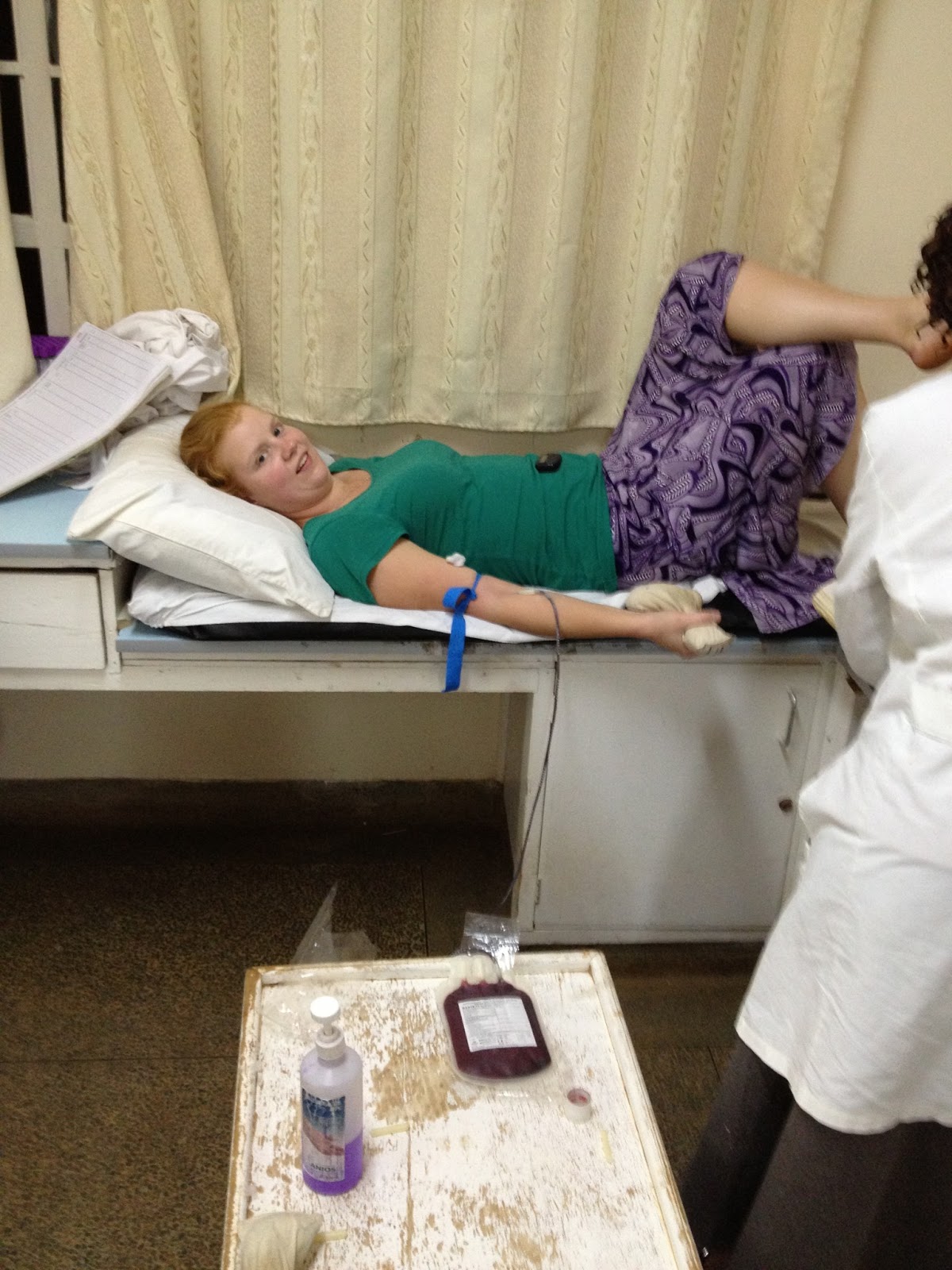
A patient needed blood - so I gave some, and I did not faint. 

My O2 tank filling station

What do I do?

So I’m a little tired right now, hoping to catch up on my sleep…eventually. I probably work at the hospital about 50hrs/week and then come home where there is more work: catching up on e-mails, helping out with visiting staff, working on equipment etc.  My days are very diverse. I don’t know what to expect each morning when I wake up but rarely am I bored.
To give you an idea about how I spend my time here’s what I have done in the past week:
·         Assisting with the ventilation of multiple patients from a 14 month old with ???, to a young OB patient with serious bleeding problems, to  the youth with ARD’s– and a few others.
  •    Held babies – they are in ICU and crying, the nurses are busy so I make sure the child does not fall out of bed.
  •  Gave blood – the patient was in severe need of blood with clotting ability, which here is only in fresh blood, so at midnight I gave her some.
  •   Attended lectures on cardiac tamponade, pulse oximetery, hirshprungs disease.
  •   Gave representatives from Coviden (medical company) a tour of the hospital
  •  Practiced Swahili with the nurses over chai breaks – learned today that my pronunciation for understand(elewa) is to close to the word drunk (lewa) or married (olewa).
  •    Fixed/trouble shooted ventilators
  • Sorted supplies in the storage room
  • Gave many informal lecture from CXR to Evac tubes
  • Talked with a Dr from another hospital about their new ICU – I will probably visit there when they are running to provide education
  •  Did CPR – I usually do this at least once a week if not more
  •  Helped with Intubations
  •  Weaned O2 on various patients
  •  Helped out the physicians by finding lab results, taking verbal orders when the Dr is busy doing surgery, providing vent support
  • Bagged patients – We don’t have a ventilator in ER so when we intubate some one needs to stand there and bag – usually end up being me.


I am sure I missed something but that gives you a general idea. I am on call 24/7 so while many of these things happen Monday-Friday between 7am and 5pm some happened at 5am or during supper on Sunday. And that is just fine.

Sunday, June 23, 2013

Mystery Case

So I thought of titling this case of the week but I don’t think I will be doing this regularly – this is case that has mystified the internal medicine service so if you think you have an answer please let me know. For all my non-medical friends sorry if this is boring/confusing I will get an update more about life soon, I do ask that you hold up this young man in prayer.  Also as I would like some feedback soon I have posted this post before my editor reviewed it I apologize for any grammar/spelling errors.

I got called to meet Kibet (not his real name) last week, a 20 something year old man. He had come into casualty (Emergency Room) talking and complaining of difficulty swallowing and shortness of breath. Over his time in casualty he deteriorated and became obtunded. When I was called to see him he was unconscious GCS – 3 and his RR was 10. We started bagging and intubated him. The intubation took some time as we were teaching the interns by the time we got the tube in his GCS had improved to maybe a 6. By the time we got him to ICU we had to give him Versed to keep him calm to keep the tube in. I set him up on the vent (Servo 900C). He was happier on the vent and no longer required versed. I turned him to pressure support but he had no Respiratory drive, so we left him on A/C. After some time on the vent An ABG was done with a pH of 7.56, PaCO2 30, HCO3- of 32 (I’m pulling it from memory so it’s not exact) We left him on the vent overnight and the next morning he was triggering the vent some so I placed him on SIMV hoping to wean him some. An upper GI Scope was done which was normal as was a Lumbar puncture which showed increased WBC – so possible Meningitis. We started treatment for bacterial meningitis.
The next morning he was triggering the vent better and we extubated him by mid-morning. A blood gas done a few hours later was pH 7.46, PaCO2 40 and HCO3 of 28 (again from memory). Also throughout his whole time he has not been hypoxic/requiring O2.
The patient was quite awake and co-operative both on and off the vent. Once he was off the vent  we were able to get a better history, he has had trouble swallowing for about 3 months – which is not a normal time frame for bacterial meningitis so we are thinking maybe TB meningitis??? He has not been working the past few months as he has been weaker than normal however he had reasonable leg/arm strength.
The next few days myself and the medical team expected him to get confused and hypercarbic again. As we think something neuromuscular is going on. The patient did well. I would find him in a chair, having coherent conversations and no signs of Resp. distress. We did not do serial ABG’s as they are about a day or 2 wage here.
However this morning I got called out of bed – he has done it again and is obtunded again. We grab another ABG pH 7.15, PaCO2 – 104, HCO3 – 34. Rather than intubate him again we place him on bipap. Within 45 min he is awake and doing well. This time as he was in ICU we were able to better watch his deterioration – apparently his Blood pressure is very positional, he is comfortable sitting straight up with his head arched back and with his legs bent underneath him.
So now he is on and off BiPap I talked to him this afternoon and the bipap his helping – however what is the problem. Is it treatable? I can’t send him home on Bipap as I don’t have enough machines. Anybody have any ideas – feel free to comment on this blog or e-mail/facebook me. Please also hold up this man in prayer.
Thanks

Annette 

Thursday, May 30, 2013

Work in the basement

So it is high time I get a blog post up. I have been debating about what to write those of you wanting stories from the hospital it’s the same as last time. My ventilators don’t always work, patients are very sick, and I am enjoying being part of the team here.
Today I have been having a new adventure. Tenwek being a mission hospital gets many things donated. These things all end up on the shelves in Central Supply, much of the donated equipment is used and put to good use however among every container of donated supplies is the junk. Things are donated because they are no longer needed by the place that donated them. Maybe it was a mistaken purchase so its fine for us to use or it is something completely random that would never be used – ever. When I was here two years ago I spent some time in Central Supply familiarizing myself with the items on the “respiratory shelves” which is a lot of equipment from little connectors to 40 feet of oxygen tubing.  Amoung these shelves I also find the obscure like hoods – no clue what these hoods are for – I think maybe the OR. Although now that I am writing this I should double check and see if they’re oxyhoods. Anyway I was asked today to assist the staff in going through these shelves. It is tedious dusty work but I am enjoying it. We emptied one whole shelf today. I found some treasures: in-line suction catheters and incentive spirometers, and sent some things to the trash: water traps are useless when your humidification is HME. I also have matched up some supplies to other areas of the hospital such as double lumen endo tubes to the thoracic surgeon, he did not know we had them – we have 38.
I will probably end up spending a week down there taking breaks to see my patients and respond to pages. Today breaks involved doing CPR, chest physiotherapy and some ventilator checks, as well as a few e-mails to Europe as someone there has some equipment he wants to donate and wants to be sure its appropriate, I am so thankful he asks.
I will end with a few pics of my work. 
I head to work around 7am and caught this beautiful sunrise out my front door.

We have been having trouble with the power to our CT scan, so we now have all these batteries to  hopefully fix it.

This is currently behind the hospital, not sure why?

Today I emptied the shelf on the left tomorrow the right, then the next one. 

Friday, May 17, 2013

Home at Tenwek


So I should be preparing my lecture for next week, or figuring out how the new (to me) spirometer works or reviewing my Swahili. But I think you all deserve an update on what I am up to so I will write this instead, and work on the rest later.  I work the best under pressure.

I finished language school with my final oral exam on May 9 and the next day headed to Tenwek. I got here just in time for new missionary orientation. This was a time spent with missionaries who have been in Kenya from anywhere from 8 months to a few days. This was a good start to my life at Tenwek, although it did delay the unpacking a bit. I gave myself Monday off to get settled in and meet my house help, a wonderful lady who will be coming 2 days a week to help me out with cooking, cleaning, shopping and laundry. Her help is an excellent bridge into the culture around me as well as frees me up to spend more time in ministry – whether working at the hospital or the surrounding community.

I am staying in the home of a long term missionary who is currently on furlough. She has generously let me use her furniture and kitchen stuff. It is great to move into a furnished home all I had to do was unpack the bags and hang pictures on the wall.

I made it to Tenwek just in time for a graduation ceremony of one of the Family Practice residents I worked a lot with in my last term at Tenwek. Dr M. is a wonderful doctor and I am sad to see him go. We had a fun graduation evening. I skipped out of some of the speeches to play with his 2 young boys who thought this Muzungu (white person) who attempted to talk Swahili was interesting.
Sugar high=Smiles
Good-bye Dr M, we will miss you. 

I headed to work Tuesday morning. Introduced and reintroduced myself to many of the staff here many names and forgot many of them – a challenge of working everywhere in the hospital is I work with almost everyone and it makes for a lot of names to remember or more often forget.
All set for my first day at work

My days have been busy the first day I attended 3 different codes, assisted with 2 intubations and functioned as a ventilator as we waited to get a bed in ICU. I am quickly refamiliarizing myself with our equipment and the challenges we face here;  I have already had to bag patients because of malfunctioning oxygen system, my pockets are overflowing with all sorts of necessities from Peep valves to hand sanitizer, and  I have been called out of bed at midnight to help out with our ventilator that has its idiosyncrasies. I have been busy working from 7:00 or 7:30am until  5:30 or 6:00pm, long days however I am loving it. It is great to help out the career missionaries and shoulder some of the load of working here. I also love sharing knowledge with the staff as we learn from each other.

I have appreciated my time spent learning Swahili. I have been having chai with the nurses and being able to be a part of, or at least understand, some of the conversation going on around me has been great. The staff has also been very encouraging speaking to me in Swahili and saying it again when I ask and telling me what word is what. I have been able to do basic respiratory assessments in Swahili  it’s not always right but I am learning and when the patient laughs at my Swahili mistakes it’s a good form of chest physiotherapy.

Well I should end there, and get some lectures written. I ask for your prayers in the continued months as the novelty of working here will wear off and become routine I will need strength both physical as the days are long and emotional as I see a lot of death each week. I need to continually remind myself that healing the physical body is a good goal but the spiritual body is even more important. 

Tuesday, May 7, 2013

Last few days of School


I have completed my last few days of language school. May 10thI will be moving again, for the last time for a while, to Tenwek. My classmate finished last week  so that left just me in my class for the last week and a half. I  stopped working through the textbook and instead I had the teachers teach me medical things. Medicine in Kenya is done in English(the staff all communicate in English regarding medical matters) but the patients may only speak Swahili and their tribal language, or just their tribal language– in which case my learning will not be helpful but this is still time well spent.

To illustrate the importance of the time I have spent learning Swahili over the last three months here is a true story from last week. It was a holiday in Kenya and I took the opportunity to head into Limuru to pickup a few things. I went by matatu (after walking a mile to the main road). I got in a matatu where not much communication is needed, after you are seated you get a tap on the shoulder and/or a look that is your cue to pass up your fare and say where you are going. No need to speak Swahili there. After I had paid there was some confusion between the tout (guy who collects the fare, not the driver) and a passenger over the fare. This fellow ended getting off thematatu early saying in English “how would I know I don’t speak Swahili”. Now this fellow blended into the population much better than I did, and when he got off there were a few murmurs of “he should speak the national language”. At this point I turned to my seat mate and said “Nasema Kiswahili” (I speak Swahili).This spread some smiles around the matatu, and it reminded me that communication is only one of the goals of language it is also to be a part of the culture, to show respect and to be able to be one of the crowd.

So since last weeks holiday, I returned to school and continued to make my lovely mistakes. The other day I mistakenly said “when my brothers and I were cows” Instead of when my brothers and I had cows – introduced much laughter to our lunch break. I am sure that was not my last mistake and I will daily make more.

I ask that you pray for me in these final days of formal language study – that I will continue to learn and that I will know how to best focus my class time. These past 2 weeks have been fun. During the mornings I create my lesson plan – we joke that I have a clinic, and it’s not far from the truth. I am explaining, in Swahili, how to manage asthma and we are doing “spirometries”. One of my teachers desires to be an actor and he is loving putting his skills to use when I tell him – Ok you are coming to the clinic because you are short of breath. I have  learned the words to use during chest physiotherapy – interesting as the best word we have is "beat the patient", hopefully I don’t scare them away.

My next post will be from Tenwek my home for the next 2 years - the time has finally come.