Sunday, September 8, 2013

Saturdays

A few weeks ago I was asked by a short term Tenwek Visitor what I do on weekend off – I didn’t have a great answer for her. Why? Because I am doing life here. Living here is not a long holiday but normal things. Just like you sitting in your house right now, my Saturdays are busy.  Last weekend was a slower pace.  I was watching two boys as their parents were  gone for the weekend. They are ~11years old and therefore fairly easy. However, being responsible for them has given me an excuse to turn down some other requests for the weekend so it was rather relaxing – I took a short nap, backed up my computer, baked some cookies.
I also made 2 trips of to the hospital. We have been having a difficult problem, I only have four functioning ventilators and they are all in use. Last Saturday, I got a call as they needed to intubate a fifth person and needed a ventilator. OK. Hard decision time – we tried one of the patients on T-piece and she did okay so her ventilator went to the next patient. I also looked at the other three patients on ventilators trying to figure out if I get called again, who is next?  Is it the septic young man, the fellow who has poor muscle strength for unknown reason or the craniectomy patient who is not waking up? Hard decisions I am praying that another ventilator will not be needed until we can get the existing patients extubated. However I was able to get a plan in place with the surgeon if we need another machine. We have a few broken down machines and I am hoping they can be fixed to prevent this problem from happening again.
Anyway back to my Saturday. As you can see last weekend was rather relaxing – I am completely serious, it was. Another Saturday I was expecting a relaxing weekend but found out my Youth Group had a soccer tournament at Tenwek. Being there to show support to these boys is important so I spent the day in the sun watching soccer – it was a fun day but not the day I expected to have as I only found out about it the day before.
The weekend before that I had an adventure with my ICU and HDU nurses we travelled to a place called 14 falls on the way we stopped for chai.  Chai to Kenyans is like coffee time for Dutch people, it must happen. We also stopped to see a pineapple farm – I had never before seen pinapples grow, I thought they grew like cabbage but they are off the ground – it was neat to see. The water falls were beautiful, however, I was disappointed by the amount of pollution in the water. Usually I am the first one to get my feet wet but I refused to touch this water. Regardless the day was fun and it was great to spend time with my co-workers outside of the hospital.  
That is life at Tenwek. I often wonder where the time goes as there is always something to do, someone with a need, or a game to play. Please pray for me to have wisdom and strength for the busy times and the courage to say no.

 
14 Falls

Soccer game

Thursday, August 15, 2013

Where has the time gone?

Two weeks ago, I reached the seven month mark since arriving in Kenya, my six month tourist visa had already been extended for a month, and I was still waiting for my work permit. So a few days before the expiry, I started to make some phone calls about where I was at. I had numerous conversations while continuing to help with a sick child. Conversations progressed from having to travel out of country for a few days to being told to go to Nakuru, 4 hours away, as there is a helpful immigration official who will help me out. So I ran home, grabbed a quick bite to eat, called a driver to pick me up in an hour, sorted out who would feed the dog I was watching, and put some things in a bag. Off I went to find my car – to my surprise there were two drivers. I went off with the one who I was told was coming. I had a good weekend in Nakuru relaxed in the home of the country directors of WGM Kenya, wonderful people. I also got to do some fun shopping, eat some tasty Chinese food and most importantly I was able to get a two month extension on my visa. Hopefully before Oct 2, I will get my work permit, or I will have a repeat of two weeks ago.

The second weekend of August was also busy. I headed out to Nairobi as I had a Respiratory Therapy student coming to Kenya for two weeks to work at Kijabe and Aga Khan Hospital. His coming was part of another group I am involved with called Respiratory Therapists Without Borders. Sunday afternoon the RT student and I arrived at Kijabe hospital we got settled in and planned our lecture for the next morning. Monday and Tuesday were busy. We gave two lectures a day, checked  and fixed baggers, put together about 40 new baggers, did rounds, checked out all the vents, etc. Tuesday afternoon a second RT arrived from Canada – three RTs from Canada in one place in Kenya – WOW. I spent the afternoon orientating the new RT and then I packed up and returned to Tenwek. These two RTs will complete the week at Kiajbe and hopefully have a good experience.   Maybe they will return to Kenya or help out elsewhere in the future. I was also thankful that these individuals brought many supplies that were split up by three mission hospitals in Kenya,- Kijabe, Tenwek, & Litein.
A lot of baggers - THANK YOU

The view from my front door a Kijabe - the Great Rift Valley

Three Candadian RTs in Kenya

Tuesday afternoon, I left to return to Tenwek. The driver and I left at 4pm which should have given us plenty of time to be back at Tenwek before dark, as traveling after dark here is not advised. So we left Kijabe and got to the town at the bottom of the hill. We stopped in a gas station and were told “hakuna” (there is none).  The driver said we will be fine until Narok. So we stopped in Narok, at the first station we heard "hakuna", the second station: "hakuna", the third station: "hakuna". The fourth station we saw a fuel truck ready to unload and 100 piki pikis (motor bikes) and 75 cars in line. The driver looked at the gauge and said we should be fine. Five minutes out of town the low fuel light turned on so we turned around and joined the line. The fuel delivery truck had just arrived so first we waited for him to unload and then the line started to move. We slowly inched forward until eventually our turn came. The Piki Piki’s were in line first and they just kept coming. Also other piki piki drivers would get to the front with an empty bottle pay for their 1 liter and happily take off. We waited about an hour and a half to finally get gas and then it was dark and rainy making the hour and a half drive to Tenwek not fun. I was thankful for a good driver who was familiar with the road – he knew where all the speed bumps and potholes were. I finally made it home a little after 9pm. A three hour trip that turned into five hours.

So now I am back to work.  Please say a prayer for us at the hospital as we have a lot of head injuries and other traumas lately. Also recently, we had a morning where in the space of three hours we coded and lost two babies under the age of one, both in the ER department.  Please pray for the families as well as all the staff and me as it was a tough morning.


The line for gas
This man was excited to get his 1L of gas - yes it is in a water bottle


Thursday, July 25, 2013

It's the little things

So what is it that makes living and working in Kenya so much different - it’s the little things. Many of these things are good and many of them drive me crazy. Sometimes it’s the same things that at one point I will enjoy and another time will make me crazy.

To illustrate these points I will show case a few normal everyday things that are made different by little things.

My walk to or from work.
I love that my house is just a short walk (300m) to work. Mornings are beautiful with the sun peaking up over the clouds, the birds are singing and its quiet with no hi-way noises. When I reach the road I take a quick peak to make sure there is no motor bike coming up the road. I often see a certain motor biker waiting for his passengers. He wears a Canada Post Jacket. It’s a nice touch of home. Often when walking home I get delayed with greeting people. Here a simple hi or wave is not appropriate. You must shake hands and ask how things are going. The other day I met a young man from my youth group. I saw the cows that he herds before I saw him. We chatted for a bit as his cows kept walking on, once the conversation was done he went off and tracked down the cows – he said they knew the way. There is no rushing or worrying. This is a great thing…outside the hospital.


Cows in my back yard

Making Supper
I have house help a lovely lady who comes a few days a week to help me with cooking, dishes, laundry etc. However the other day I had some visitors for supper on a day when J was not around. So supper was up to me. I asked a friend to pick up some lettuce from Nairobi. Once I got the lettuce we (my roommate and I) washed it in a weak bleach solution and then rinsed it in filtered water. We had to do the same with the tomatoes. Avocadoes are in season so we had fresh guacamole. I walked to a few different fruit stands before I found the limes needed to go in the guacamole. I took three and asked how much. I was told 30 shillings. I paid and the lady gave me 5 limes. Not quite sure how that worked, and I did not really need 5 limes but it was easier that way. I had J make the tortillas the day before so I did not need to worry about that and I had some taco spice from a visiting Dr. There. Tacos done. I picked tacos because it was an easy meal.
 
A different night when we had a lasagna making lesson
Work
I can’t outline all the little things that make work different but here’s just a simple story that has happened many times. This is a typical story and here’s how it may go.
I get paged to help out in casualty (ER) I find a young lady in the back room unconscious, not on a monitor and a Dr saying we probably need to intubate. I go assess the patient – make sure she is still breathing, check her sats and see how awake she is. As these are all fine I go set up for intubation. I set up suction – I grab the tubing and canister off the drying rack as they have just come out of the bleach we use to disinfect. I discover that one of the tunings does not quite connect to my yankeur so I go find another one. I take the bagger out of the bags we recently hung that should contain my needed supplies, I discover that the mask is the wrong size so I dig through  a container of masks mixed with random connectors and find a better one. Get the laryngoscope out of the drawer – thankful that we have a complete laryngoscope set in a good box. Now that I am all set up the Doctor and I and possibly a nurse go to put the tube in after the 2nd attempt the tube goes in the lungs – I hear air entry on both sides and the SpO2 stays good –confirmed ETT placement. Now the patient who was previously breathing isn’t breathing so much on her own. So I stand in casualty and breathe for her by squeezing a bag. While doing this I keep the gastric lavage going to clean out her stomach. I cannot leave the patient for more than a few seconds at a time as if I leave patient does not breathe. After 30-60min I hear we have a bed ready in ICU but they need me to go setup the vent. So I call a nurse to take over my job of bagging and head to ICU. The nurses set up the vent well and with a minor change we are ready -  I tell them I will be back in a few minutes with the patient. I walk back to casualty and grab an oxygen cylinder to use as we transport the patient – but after turning it on I discover it’s empty. I than switch the regulator to the next tank. It’s also empty. I walk back to ICU and ask to borrow there tank they give me permission as long as I promise to return it. I turn it on and discover there is a large leak around the regulator. I remove the regulator and see that there is no O-ring to help seal the regulator to the cylinder. I find an empty plastic IV bottle and cut it up to make an O-ring. I manage to finally to get it to seal and then I hear a commotion behind me. The casualty staff decided they were sick of waiting for an O2 cylinder so they made a mad dash from casualty to ICU. The patient is still on my SpO2 probe – the only monitor aside from the odd BP we have done since her arrival at Tenwek, anyway the mad dash brought her SpO2 down to 83 – not bad. I throw her on the vent and she recovers. The casualty staff take their bagger back to casualty and I hunt up an ICU bagger to keep by her bedside in case the power goes out and my vent shuts off. The first bagger I find has a small leak – I pull out the glue that is in my pocket and seal it. Now we are good to go. Patient looks good on the vent and is stable. Hopefully she will wake up in the next day or two and then we can take her tube out.


Rounding outside on our ICU patients. They have (all 3) recovered from their suicide attempts.


So I will end there. Please pray for me for patience to deal with and enjoy the little things.

Tuesday, July 16, 2013

Mystery Patient Part 2

So a few weeks ago I shared here on this blog about a mystery patient. I have been asked to share what we figured out with the patient. The truth is we figured out nothing. He remained in HDU(High Dependeny Unit - same as a step down ICU) for a few weeks with intermittent episodes of increased work of breathing and increased PaCo2- 105. In between the episodes he would have some signs of mildly increased work of breathing but was otherwise fine. He would walk around, eat, talk etc. We did a few blood gases during these periods and they were normal.

After doing this for many days with no diagnosis in sight and realizing that whatever the diagnosis was we probably could not treat it. With this knowledge in mind a discussion was held with him and his family and a decision was made to send him to the general ward and stop the bipap. A few days later he went home. He was off the bipap for about 5 days straight before he left and had no episodes. I don't know if God healed this young man or if he since he went home and he passed on. However, I do know that this man knows the Lord and whatever happens I will see him again whether here or in heaven.

Saturday, July 6, 2013

Mimi Fundi wa kupumua

Being a respiratory therapist I am used to the question: what is it that you do? I have blogged about it a few years ago when I came to Tenwek the first time. In attempts to explain what I do I have changed my job title to Fundi wa kupumua. Fundi is a Swahili word which in language school we defined as expert. Here at Tenwek I have been told it refers to a repairman. I think either work. Kupumua is breathing. So literally translated I am the repairman of breathing.
 I have had some debates but I like the title.
The fundi part of the title here is a lot more true here than back in Canada. My troubleshooting of ventilators goes a lot further than “it doesn’t work” – I have a closet full of exhalation valves and flow sensors which I pull out when needed. I also walk around with a wrench in my pocket and have started filling O2 cylinders (E size). I am hoping to learn how the O2 and air compressor works and how to trouble shoot them so when there are problems I can fix them. This is something that is currently done and I will in no way assume the duties from technical but rather share the load.
Today I learned that when filling tanks I can’t hear my pager – something I need to remember as I start doing this more often.
Don’t think I am filling tanks and becoming a mechanic because I am bored – that is far from the truth. I am doing it as its necessary to be done and helping out the technical service with simpler tasks frees them up to fix my ventilators that are out of my expertise.

On the kupumua (breathing) side of things I have been busy this week. We have some visitors from America who are helping us out with cardiac surgeries. We are doing one case a day. This week has been mitral valves, next week will be aortic valves. I get involved with the patient post-op as we wean off the ventilator and get the patient stabilized. As we do not have an intensivist managing the patients post-op it can be interesting as the responsible physicians are busy doing surgery. If problems arise the nurses and I figure something out as one of us relays info back and forth to the operating room.

This week I started a relationship with another mission hospital about 45min away, so not far. They are in the process of opening an ICU and I am advising them on things. I will probably making 2-4 trips a month for the next few months providing education to the nurses and physicians there. Its fun to help create something and I pray that they do well.


Here are some random pictures of life and work.
Chai time in ICU - one of our patients joined us/

An evening game of balderdash

My ICU nurses excited about the "new"monitor- if only we could get it to work  all the time

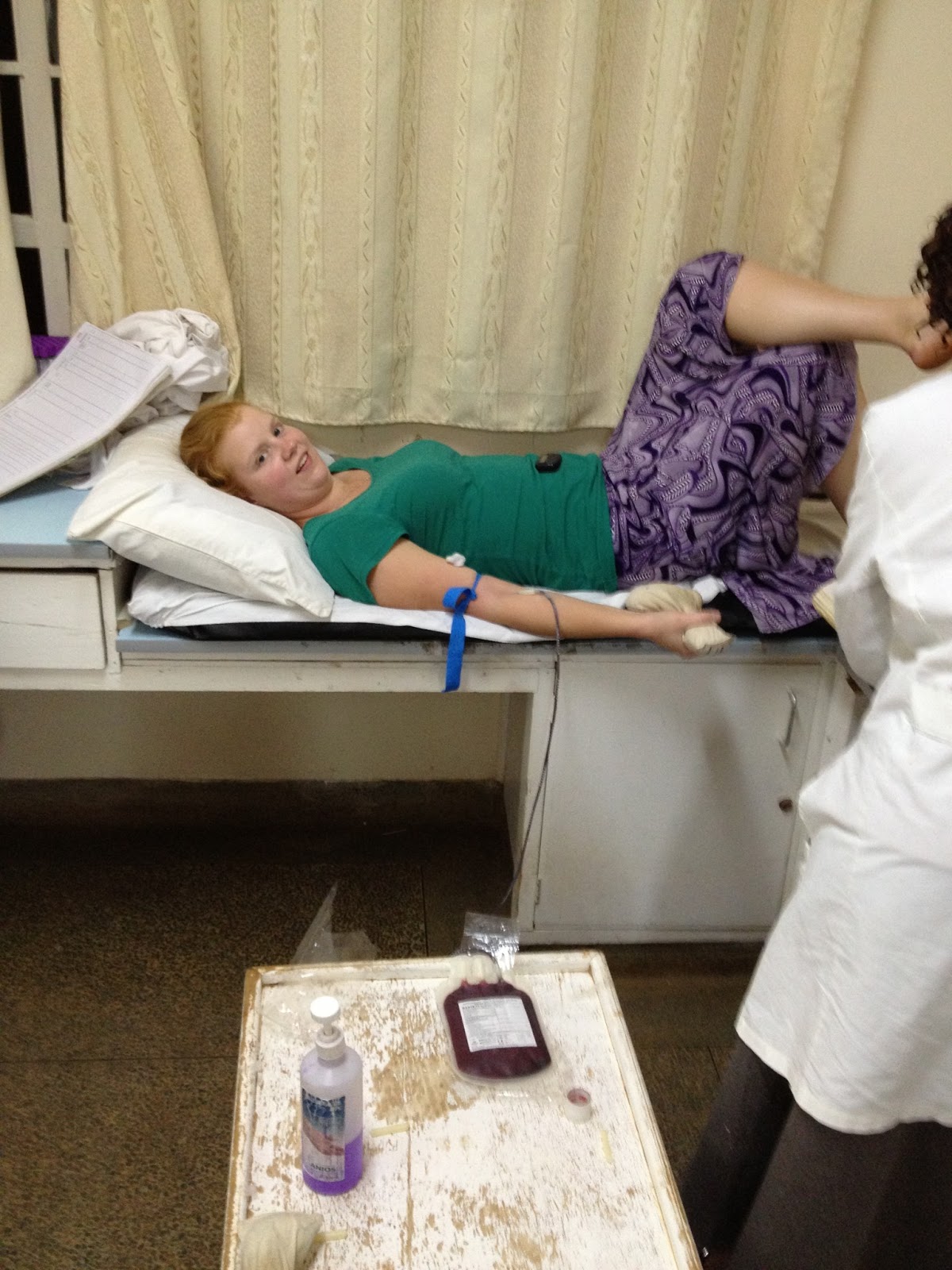
A patient needed blood - so I gave some, and I did not faint. 

My O2 tank filling station

What do I do?

So I’m a little tired right now, hoping to catch up on my sleep…eventually. I probably work at the hospital about 50hrs/week and then come home where there is more work: catching up on e-mails, helping out with visiting staff, working on equipment etc.  My days are very diverse. I don’t know what to expect each morning when I wake up but rarely am I bored.
To give you an idea about how I spend my time here’s what I have done in the past week:
·         Assisting with the ventilation of multiple patients from a 14 month old with ???, to a young OB patient with serious bleeding problems, to  the youth with ARD’s– and a few others.
  •    Held babies – they are in ICU and crying, the nurses are busy so I make sure the child does not fall out of bed.
  •  Gave blood – the patient was in severe need of blood with clotting ability, which here is only in fresh blood, so at midnight I gave her some.
  •   Attended lectures on cardiac tamponade, pulse oximetery, hirshprungs disease.
  •   Gave representatives from Coviden (medical company) a tour of the hospital
  •  Practiced Swahili with the nurses over chai breaks – learned today that my pronunciation for understand(elewa) is to close to the word drunk (lewa) or married (olewa).
  •    Fixed/trouble shooted ventilators
  • Sorted supplies in the storage room
  • Gave many informal lecture from CXR to Evac tubes
  • Talked with a Dr from another hospital about their new ICU – I will probably visit there when they are running to provide education
  •  Did CPR – I usually do this at least once a week if not more
  •  Helped with Intubations
  •  Weaned O2 on various patients
  •  Helped out the physicians by finding lab results, taking verbal orders when the Dr is busy doing surgery, providing vent support
  • Bagged patients – We don’t have a ventilator in ER so when we intubate some one needs to stand there and bag – usually end up being me.


I am sure I missed something but that gives you a general idea. I am on call 24/7 so while many of these things happen Monday-Friday between 7am and 5pm some happened at 5am or during supper on Sunday. And that is just fine.

Sunday, June 23, 2013

Mystery Case

So I thought of titling this case of the week but I don’t think I will be doing this regularly – this is case that has mystified the internal medicine service so if you think you have an answer please let me know. For all my non-medical friends sorry if this is boring/confusing I will get an update more about life soon, I do ask that you hold up this young man in prayer.  Also as I would like some feedback soon I have posted this post before my editor reviewed it I apologize for any grammar/spelling errors.

I got called to meet Kibet (not his real name) last week, a 20 something year old man. He had come into casualty (Emergency Room) talking and complaining of difficulty swallowing and shortness of breath. Over his time in casualty he deteriorated and became obtunded. When I was called to see him he was unconscious GCS – 3 and his RR was 10. We started bagging and intubated him. The intubation took some time as we were teaching the interns by the time we got the tube in his GCS had improved to maybe a 6. By the time we got him to ICU we had to give him Versed to keep him calm to keep the tube in. I set him up on the vent (Servo 900C). He was happier on the vent and no longer required versed. I turned him to pressure support but he had no Respiratory drive, so we left him on A/C. After some time on the vent An ABG was done with a pH of 7.56, PaCO2 30, HCO3- of 32 (I’m pulling it from memory so it’s not exact) We left him on the vent overnight and the next morning he was triggering the vent some so I placed him on SIMV hoping to wean him some. An upper GI Scope was done which was normal as was a Lumbar puncture which showed increased WBC – so possible Meningitis. We started treatment for bacterial meningitis.
The next morning he was triggering the vent better and we extubated him by mid-morning. A blood gas done a few hours later was pH 7.46, PaCO2 40 and HCO3 of 28 (again from memory). Also throughout his whole time he has not been hypoxic/requiring O2.
The patient was quite awake and co-operative both on and off the vent. Once he was off the vent  we were able to get a better history, he has had trouble swallowing for about 3 months – which is not a normal time frame for bacterial meningitis so we are thinking maybe TB meningitis??? He has not been working the past few months as he has been weaker than normal however he had reasonable leg/arm strength.
The next few days myself and the medical team expected him to get confused and hypercarbic again. As we think something neuromuscular is going on. The patient did well. I would find him in a chair, having coherent conversations and no signs of Resp. distress. We did not do serial ABG’s as they are about a day or 2 wage here.
However this morning I got called out of bed – he has done it again and is obtunded again. We grab another ABG pH 7.15, PaCO2 – 104, HCO3 – 34. Rather than intubate him again we place him on bipap. Within 45 min he is awake and doing well. This time as he was in ICU we were able to better watch his deterioration – apparently his Blood pressure is very positional, he is comfortable sitting straight up with his head arched back and with his legs bent underneath him.
So now he is on and off BiPap I talked to him this afternoon and the bipap his helping – however what is the problem. Is it treatable? I can’t send him home on Bipap as I don’t have enough machines. Anybody have any ideas – feel free to comment on this blog or e-mail/facebook me. Please also hold up this man in prayer.
Thanks

Annette